
Álvaro García
One of the most repeated phrases in dairy nutrition is also one of the most accurate: “there are three rations on every dairy farm.” There is the ration the nutritionist formulates, the ration that is mixed in the feed wagon, and the ration the cows finally consume.
When these three rations align, cow performance is predictable. Milk yield, components, and feed efficiency respond as expected. When they drift apart, results become inconsistent and frustrating. Milk production may drop, components fluctuate, and health issues emerge, even though the ration on paper looks correct.
Understanding where these three rations diverge, and why, is essential for improving consistency, efficiency, and profitability in modern dairy systems.
The ration we formulate
The first ration is the one designed on paper or in your software. This ration is built to meet the nutrient requirements of a specific group of cows based on milk production, stage of lactation, body weight, and predicted dry matter intake. Energy, metabolizable protein, fiber effectiveness, starch fermentability, minerals, and vitamins are balanced to support milk production while maintaining rumen health.
This ration assumes accuracy at several levels. Forage analyses must reflect what is fed, not what was sampled months earlier. Dry matter values must be current. Inclusion rates must match reality. Intake predictions must be reasonable for the cows, environment, and management system.
On paper, this ration is precise. In practice, it is only a target. The moment the formulation leaves the nutritionist’s computer, it becomes vulnerable to variation.
The ration mixed
The second ration is the one that goes into the mixer wagon. This is where most deviation begins. Even small errors in ingredient loading can create meaningful nutrient variation. Overloading or underloading forage by a few hundred pounds, inconsistencies in byproduct inclusion, or failure to adjust for dry matter changes can shift starch, fiber, or protein concentrations enough to affect rumen function.
Ingredient order and mixing time also matter. Long fiber should enter the mixer first, followed by concentrates and liquids, to ensure proper fiber processing and uniform distribution. Under mixing results in ingredient separation. Over mixing can reduce effective fiber length and promote sorting.
Mixer condition and management further complicate consistency. Worn augers, damaged knives, or uneven mixer capacity can create variability even when protocols are followed. Differences between operators and shifts can compound the problem.
At this stage, the ration has already diverged from what was formulated. However, cows are still not eating this ration either.
Mixer configuration and loading sequence are among the most controllable sources of ration variability. Differences between horizontal and vertical mixers require distinct loading strategies to achieve consistent mixing and prevent segregation (Table 1).
Table 1. Recommended feedstuff loading sequence (horizontal and vertical mixer wagons) |
||
Step |
Horizontal mixer wagon (auger/paddle type) |
Vertical mixer wagon (single or twin screw) |
1 |
Wet forages (e.g., corn silage, grass silage) |
Long dry forages (e.g., hay, straw) |
2 |
Short or pre-chopped dry forage (haylage, chopped hay) |
Pre-mix / pre-chop long forage (30–90 s) |
3 |
Concentrates and energy feeds (grains, DDGS) |
Wet or ensiled forages |
4 |
Protein meals and by-products |
Concentrates and energy feeds |
5 |
Minerals, vitamins, buffers (preferably pre-blended) |
Protein meals and by-products |
6 |
Liquids (molasses, fats, liquid supplements, water) |
Minerals, vitamins, buffers |
7 |
Final mixing (3–5 min after last ingredient) |
Liquids added evenly during mixing |
8 |
— |
Final mixing (3–5 min after last ingredient) |
Table 2. Operational considerations affecting mixing efficiency in horizontal and vertical mixer wagons |
||
Parameter |
Horizontal mixer wagon |
Vertical mixer wagon |
Forage length tolerance |
Low–moderate |
High |
Ability to process long hay |
Limited |
Excellent |
Risk of poor mixing |
Dead spots if long forage added early |
Over-processing if mixed too long |
Ideal forage moisture |
Moderate to high |
Wide range |
Sensitivity to loading order |
High |
Moderate |
Common management error |
Adding long forage first |
Excessive mixing time |
Recommended management focus |
Uniform chop length before loading |
Control total mixing time |
The ration cows eat
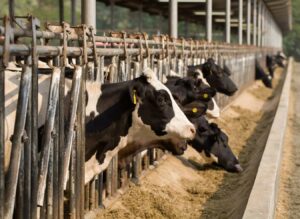
The third ration is the one consumed by the cow. This ration is shaped not only by formulation and mixing, but also by feed delivery and bunk management.
Sorting is a major driver of deviation. If cows selectively consume concentrates and avoid longer particles, the effective fiber intake drops while starch intake rises. This increases the risk of ruminal acidosis, milk fat depression, and inconsistent intakes across the day.
Feed availability and bunk space play a critical role. Overcrowded bunks increase competition and reduce uniform access. Inconsistent push-ups, delayed feeding, or extended periods with an empty bunk exaggerated intake variation between dominant and subordinate cows.
Refusals matter as well. When refusals exceed targets or are not managed consistently, the cow ration eat shifts over time. What was balanced for today’s feeding becomes diluted or concentrated by yesterday’s leftovers.
By the time feed enters the cow, it can be nutritionally different from both the formulated ration and the mixed ration.
What research shows
The importance of these differences was clearly demonstrated in a 2024 paper by Alex Bach published in the Journal of Dairy Science.
The author evaluated commercial dairies by comparing the formulated ration with the ration delivered to the cows. The study focused on deviations in dry matter, starch, neutral detergent fiber, and crude protein. These were not extreme errors, but the type of variation commonly observed on professionally managed farms.
Greater variability between the formulated and delivered ration was associated with lower milk yield and poorer feed efficiency. In other words, cows did not need a “bad” ration to underperform. They only needed an inconsistent one.
One of the key conclusions from this article was that variability itself is costly. Even when average nutrient levels were close to target, day to day swings reduced cow response. Rumen microbes, like cows, perform best under stable conditions. Frequent changes in starch or fiber supply disrupt fermentation patterns, intake behavior, and nutrient utilization.
The study reinforces a critical message; precision in formulation is not enough, precision in execution is equally important.
Why small deviations have large effects
From a biological standpoint, the rumen operates within narrow limits. Minor changes in fermentable carbohydrate supply or physically effective fiber can shift rumen pH, alter microbial populations, and affect milk fat synthesis.
From a management standpoint, variability increases risk. One day the ration may be slightly hot. The next day it may be diluted. Cows adapt poorly to constant adjustment. The result is often blamed on forage quality or cow health when the real issue is inconsistency.
This is why the concept of the three rations is so powerful. It explains why good formulations sometimes fail to deliver reliable results. Improving alignment between the three rations does not require complex technology. It requires discipline.
Accurate and frequent dry matter testing is key. Ingredient loading accuracy should be monitored regularly. Mixing protocols must be clearly defined and consistently followed. Feed delivery timing, push-ups, and refusal targets should be standardized.
Equally important is communication. Nutritionists, feeders, and managers must share responsibility for ration consistency. The nutritionist formulates the target, but the farm team delivers the outcome.
Take home message
There is nothing wrong with most dairy rations on paper. The problem is usually what happens between the computer screen and the cow.
The ration we formulate, the ration we mix, and the ration cows eat are rarely identical. The greater their disparity, the less predictable cow performance becomes.
Research, including the work by Bach, confirms that variability is not a minor issue. It directly reduces milk production and efficiency, even when average nutrient levels appear acceptable.
Closing the gap between the three rations is one of the most practical and cost-effective ways to improve dairy performance. Precision feeding is not just about formulation. It is about execution, consistency, and management at the bunk.
The full list of references used in this article is available upon request.
© 2026 Dellait Knowledge Center. All Rights Reserved.