
Álvaro García
For decades, the role of the dairy nutritionist has been clearly defined. Formulate balanced rations, meet animal requirements, control feed costs, and support milk production. This framework was effective in systems where most variables were relatively stable, and improvements could be achieved by optimizing individual components. That context has changed.
Modern dairy production is increasingly defined by interaction. Biological processes, management decisions, and economic constraints are tightly connected. Nutrition remains central, but it no longer determines performance on its own. What drives results is how well various parts of the system align over time. A ration can be technically correct and still fail. Not because it is wrong, but because it does not fit the system in which it operates. This is where the role of the nutritionist begins to evolve.
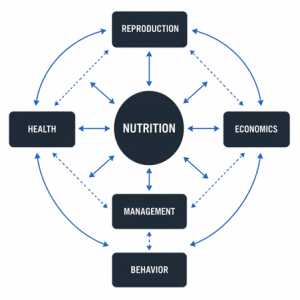
Figure 1. Nutrition operates within a system of interconnected biological, management, and economic factors.
From formulation to system interpretation
The first shift is moving from formulation to interpretation. Requirement models describe what a cow should need under a defined set of assumptions. In practice, those assumptions rarely hold perfectly. Intake varies between animals, grouping is imperfect, and health and reproductive status continuously alter nutrient demand and utilization. The nutritionist is no longer working with a static animal, but with a dynamic population responding to multiple pressures at once.
In that environment, performance problems are seldom nutritional in isolation. They emerge from the accumulation of small misalignments. A slight drop in intake around calving, a delay in recovery of energy balance, or inconsistencies in feed delivery may appear minor on their own. When combined with reproductive stress and metabolic load, they can lead to outcomes that seem disconnected from their origin. By the time they are visible in milk production or fertility records, the system has already been drifting.
This is why nutrition and reproduction are inseparable in practice. Energy balance influences fertility, but reproductive status also shapes intake patterns, behavior, and nutrient partitioning. Two cows receiving the same diet can respond very differently depending on how well they transitioned, how stable their metabolism is, and how consistently they consume feed. Treating them as nutritionally equivalent limits performance. Feeding is not only about supply. It is about response. The same principle applies to health. Clinical disease is a late-stage event. Before it appears, there are measurable changes in intake consistency, day-to-day production, and efficiency.
These changes are often subtle and fall within acceptable ranges, which makes them easy to overlook. Yet they represent the earliest indication that the system is losing precision. Early deviations in intake and metabolic stability during the transition period have been consistently associated with downstream health and reproductive outcomes, even before clinical signs are evident (LeBlanc 2010). Identifying these signals requires continuous evaluation rather than reactive adjustment.
Variation, economics, and system alignment
One of the most important indicators of this loss of precision is variation. Herd averages can remain stable while internal dispersion increases. Some animals compensate, others underperform, and the average hides both realities. Over time, this reduces efficiency and increases risk. A system that appears stable can, in fact, become more fragile. Changes in feeding behavior, intake patterns, and daily performance reflect system-level interactions rather than isolated nutritional effects, as has been observed in integrated dairy systems (King et al. 2016).
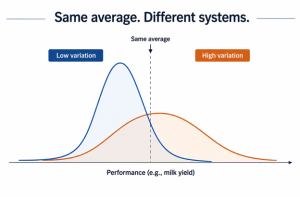
Figure 2. Systems with the same average performance can differ significantly in variability, with important implications for efficiency and risk.
Working with variation changes the approach. Instead of asking whether the ration meets requirements, the question becomes whether animals respond consistently and predictably. The focus shifts from targets to distribution, from formulation to system behavior. Economic pressure reinforces this perspective. In high-performing systems, margins are shaped by slight differences. Slight reductions in feed efficiency, modest increases in health costs, or minor delays in reproductive performance can accumulate into significant economic losses. The objective is not to maximize production in isolation, but to optimize the relationship between biological output and resource use. At the herd level, decisions related to nutrition, reproduction, and longevity are inherently linked through economic trade-offs that define overall system efficiency (De Vries 2020).
This requires thinking in trade-offs. Increasing nutrient supply may improve production but also increase metabolic stress. Reducing costs may protect short-term margins but compromise long-term performance. There is no universal solution independent of context. The correct decision is the one that maintains alignment within the system.
When that alignment is achieved, outcomes often treated as separate begin to converge. Intake becomes more stable, metabolic stress decreases, reproductive performance improves, and cows remain productive longer. Variability is reduced, which improves both operational predictability and economic efficiency. Resource use becomes more consistent, which also improves environmental performance per unit of milk.
Sustainability, in this sense, is not an external objective. It is the result of a system that functions coherently.
Take-home message
The role of the nutritionist is changing, not because nutrition is less important, but because systems are more connected. The nutritionist of the future will not be defined only by the ability to formulate diets, but by the ability to interpret interactions. They will connect nutrition with reproduction, health, management, and economics. They will work with variation rather than averages, and with responses rather than assumptions.
The systems that consistently perform at a high level are not those that optimize each component independently. They are those in which components are aligned and managed as part of a whole.
Understanding and managing that alignment is no longer optional. It is where the real value of nutrition lies.
The full list of references used in this article is available upon request.
© 2026 Dellait Knowledge Center. All Rights Reserved.