
Álvaro García
Efforts to reduce methane emissions from dairy systems are accelerating, driven by environmental pressure, policy incentives, and the promise of improved feed efficiency. Feed additives designed to suppress methane production are increasingly entering commercial practice, often with the assumption that reducing methane is universally beneficial.
But biology rarely follows simple logic.
Emerging research suggests that methane is not merely an energy loss to be eliminated, but also a reflection of how the rumen is functioning. More importantly, the implications of reducing methane are not the same throughout lactation. What may be advantageous in one stage can be counterproductive in another.
For farmers and advisors, this introduces a critical question: are we reducing methane at the right time?
When less methane is not necessarily better
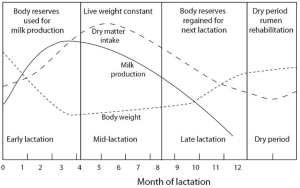
Figure 1. In early lactation, milk production rises faster than feed intake, creating a period of negative energy balance that challenges metabolism and immune function.
In early lactation, the dairy cow operates under intense physiological pressure. Energy demand rises sharply after calving, while feed intake increases more slowly. The resulting negative energy balance forces the cow to mobilize body reserves, often compromising immune function and increasing susceptibility to disease.
Within this already fragile period, recent findings comparing cows with naturally low and high methane yield reveal an unexpected pattern. Cows producing less methane per unit of feed intake did not perform better overall. Despite consuming more feed and reaching energy balance more quickly, they exhibited lower feed efficiency and a reduced immune response (Cahyo et al. 2026). This seems counterintuitive. If methane represents lost energy, then lower methane should free up energy for production and health. Yet the biological reality appears more complex.
Methane production is closely tied to rumen fermentation. It arises from microbial processes that break down feed, particularly fibrous components, generating volatile fatty acids that supply energy to the cow. Methane production is fundamentally linked to feed intake and fermentation dynamics, rather than being a simple inefficiency that can be removed without consequence García (2025a). In early lactation, lower methane yield is often associated with higher feed intake and faster passage of digesta. While this reduces methane per kilogram of intake, it can also limit the extent of fermentation, particularly fiber digestion. The cow may consume more but extract less usable energy from each unit of feed. This helps explain why cows with lower methane yield in early lactation did not show improved feed efficiency and may, in fact, have reduced immune responsiveness. In a period when energy is already limiting, even subtle reductions in fermentation-derived energy may influence how nutrients are partitioned between production and immune function (Cahyo et al. 2026).
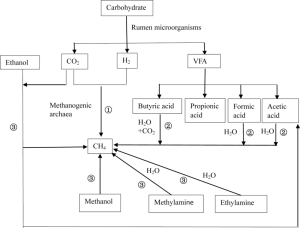
Figure 2. Methane is produced in the rumen primarily using hydrogen and carbon dioxide generated during fermentation (①) but is also linked to pathways that produce volatile fatty acids (②) and the breakdown of methyl-containing compounds (③). These pathways illustrate that methane formation is closely tied to normal rumen function and energy metabolism.
Methane as a signal of rumen activity
These findings challenge the idea that methane is simply waste. In early lactation, higher methane production may partly reflect a more active and effective rumen fermentation process.
Cows with higher methane yield in this stage showed better feed efficiency and stronger immune responses (Cahyo et al. 2026). This suggests that, despite losing more energy as methane, they were able to generate and utilize sufficient fermentation energy to support both production and immune function. In practical terms, more active rumen fermentation may have improved the breakdown of fiber and the production of volatile fatty acids, which remain the cow’s primary energy source. At the same time, the continuous removal of hydrogen through methanogenesis helped maintain a stable rumen environment, allowing microbial activity to proceed efficiently. Together, these processes may explain why cows with higher methane yield were better able to sustain both metabolic performance and immune competence during this demanding phase of lactation.
From a practical perspective, methane in early lactation may serve as an indirect indicator of rumen activity and digestive effectiveness. Reducing it aggressively during this period could risk disrupting a system that is already under strain. Methane should be interpreted within the broader context of productivity and biological efficiency, rather than as an isolated metric (García. 2025b).
Implications for methane inhibition strategies
This has direct relevance for the use of methane inhibitors on farm. These products are designed to suppress methanogenic pathways in the rumen, thereby reducing emissions. However, if methane production is linked to fermentation dynamics, then altering it may have broader consequences.
In early lactation, where cows are still adapting to increased intake and metabolic demands, interfering with rumen fermentation may not be without cost. A reduction in methane achieved at the expense of fermentation efficiency could compromise both feed utilization and immune competence (Cahyo et al. 2026).
This does not mean methane inhibitors should be avoided entirely in fresh cows. Rather, it suggests that their use should be approached with caution and always evaluated in the context of overall cow performance. The transition period remains a time when stability, not intervention, should be the primary goal.
A different picture in late lactation
The relationship between methane and cow performance changes markedly later in lactation.
In cows well beyond peak production, differences in methane yield were no longer associated with differences in immune response or feed efficiency (Cahyo et al. 2026). Animals producing less methane did not show any disadvantage in these areas, indicating that the biological trade-offs observed earlier in lactation were no longer present.
By this stage, cows are typically in positive energy balance, with more stable intake, metabolism, and endocrine function. The rumen microbial community is also more established and consistent. Under these conditions, reducing methane appears less likely to interfere with essential physiological processes.
This makes late lactation a more suitable target for methane mitigation strategies. Here, the reduction of methane can be pursued with a lower risk of unintended consequences for health or performance.
The role of the rumen microbiome
Cahyo et al. study also highlights how the rumen microbial community evolves across lactation.
In early lactation, differences in microbial composition between low and high methane-producing cows were small. This reflects the dynamic nature of the rumen during this stage, as it adapts to increasing feed intake and changing nutrient demands.
In late lactation, microbial differences became more pronounced. Specific groups of bacteria associated with carbohydrate and fiber degradation were enriched in low methane-producing cows, while methane-producing archaea were more abundant in high methane-producing cows. This suggests a more structured and stable microbial ecosystem, where methane production is more closely tied to defined microbial pathways.
For practitioners, the key message is not the identity of individual microbes, but the stability of the system. Strategies aimed at modifying rumen function are more predictable and manageable in late lactation than in the early postpartum period. Taken together, these findings encourage a shift in how methane is viewed in dairy production.
Methane is not only an environmental concern, but also part of a broader biological system that reflects rumen function and energy metabolism. Its significance changes depending on the physiological state of the cow. Improvements in productivity have historically reduced methane intensity far more effectively than direct attempts to suppress emissions (García 2025b). In early lactation, lower methane does not necessarily indicate better efficiency and may even be associated with less favorable outcomes. In late lactation, the same reduction can be achieved without apparent compromise.
For farmers and advisors, this means methane mitigation should not be applied uniformly across the herd. Instead, it should be aligned with the biology of the cow, considering the different challenges and priorities at each stage of lactation.
Timing defines success
The growing interest in methane inhibitors reflects a broader shift toward more sustainable dairy production. However, this evidence makes it clear that reducing methane cannot be treated as a uniform strategy across the lactation cycle.
In early lactation, methane is linked to rumen fermentation activity at a time when cows are under significant metabolic and immunological pressure. Intervening too aggressively during this stage may risk compromising feed efficiency and immune function, even if emissions per unit of intake are reduced. In contrast, later in lactation, when cows are metabolically stable and in positive energy balance, methane reduction appears far less likely to carry biological penalties.
For producers and advisors, the implication is straightforward but important: the effectiveness of methane mitigation depends as much on timing as it does on the technology itself. Strategies that respect the physiological priorities of the cow are more likely to deliver both environmental and productive benefits.
As the industry moves forward, the challenge will not simply be to reduce methane, but to do so in a way that aligns with cow biology. In that context, the most effective approach may not be to ask how much methane can be reduced, but rather when it can be reduced without consequence.
The full list of references used in this article is available upon request.
© 2026 Dellait Knowledge Center. All Rights Reserved.