
Álvaro García
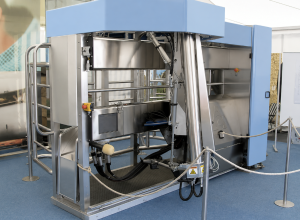
Automated milking systems (AMS) have fundamentally changed how dairy farms operate. Unlike conventional milking parlors, where cows are brought to the milking center according to a predetermined schedule, robotic systems depend heavily on voluntary cow behavior. Cows must decide when to eat, rest, drink, and visit the robot. As a result, the success of an AMS depends not only on technology but also on maintaining consistent and predictable cow behavior.
When robot performance declines, attention often turns to robot settings, gate design, fetch-cow protocols, or pellet allocation strategies. Yet one of the most overlooked factors influencing robot efficiency may be the ration itself.
A poorly mixed total mixed ration, abrupt changes in forage quality, or unexpected fluctuations in starch supply can alter feeding behavior, rumination patterns, and cow traffic throughout the barn. In conventional systems, those changes may go largely unnoticed. In robotic systems, however, they can affect voluntary visits, increase congestion, and ultimately reduce robot efficiency.
In other words, nutrition influences behavior, and behavior influences robot performance.
Free-flow or guided-flow: Different systems, same challenge
Most robotic dairies operate under one of two basic traffic philosophies.
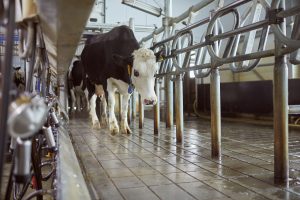
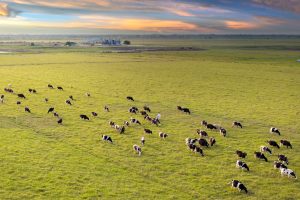
In free-flow systems, cows have unrestricted access to feed, resting areas, water, and robots. The cow determines her own schedule and movement patterns. The system relies on the natural motivation of cows to move voluntarily throughout the day.
Guided-flow systems use gates and controlled access points to influence movement. In many cases, cows must pass through specific areas or decision points before gaining access to feed or resting areas. The objective is to encourage more regular robot visits while reducing the need for human intervention.
Although these systems differ in design, both depend on predictable cow movement patterns. Whether movement is entirely voluntary or partially guided, cows still respond to the same biological drivers: hunger, comfort, thirst, social interactions, and rumen function.
This is where nutrition enters the equation.
A stable ration promotes stable feeding behavior. Stable feeding behavior promotes predictable cow traffic. Predictable traffic improves robot utilization.
Conversely, nutritional inconsistency can disrupt the behavioral patterns that robotic systems depend upon. The consequences of dietary inconsistency are similar regardless of the traffic philosophy employed (Table 1).
Table 1. Different Traffic Systems, Similar Nutritional Challenges
Characteristic |
Free-flow systems |
Guided-flow systems |
Cow movement |
Voluntary |
Influenced by gates and traffic control |
Access to feed |
Unrestricted |
Often controlled through traffic design |
Dependence on feeding motivation |
High |
High |
Sensitivity to dietary inconsistency |
High |
Moderate–High |
Typical consequence of unstable diets |
Fewer voluntary visits |
Uneven traffic and congestion |
Impact on AMS performance |
Reduced robot utilization |
Reduced traffic efficiency |
When the feed bunk creates traffic problems
For most robotic dairies, forage variability represents one of the greatest sources of nutritional inconsistency.
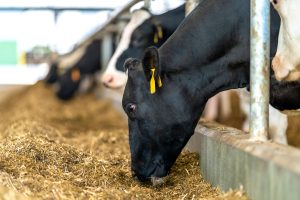
Silage dry matter can change rapidly due to weather conditions, storage practices, or movement within the silo face. The consequences extend beyond nutrient intake. Cows are remarkably sensitive to changes in ration consistency. Variations in starch concentration, fiber digestibility, fermentation characteristics, and moisture content often occur simultaneously. Unless these changes are identified and corrected, cows may experience a ration that differs substantially from the one formulated on paper. Cows are remarkably sensitive to changes in ration consistency. Sudden fluctuations in forage quality can alter meal frequency, feeding duration, sorting behavior, and dry matter intake. These changes influence rumination patterns and resting time, which in turn affect movement throughout the facility.
In an AMS environment, reduced feeding consistency frequently translates into less predictable robot visitation patterns. A similar situation occurs when starch supply changes abruptly. Whether caused by switching silage sources, changing grain processing methods, or formulation errors, sudden shifts in starch availability can alter rumen fermentation dynamics. Cows may become more selective at the feed bunk, reduce intake, or exhibit greater variability in feeding behavior. The result is not necessarily a dramatic health event. More often, it is a gradual erosion of behavioral consistency. A cow that spends less time eating may spend less time following her normal daily routine. A cow with altered rumen function may rest differently, ruminate differently, and move differently. Across hundreds or thousands of cows, those small behavioral changes accumulate into measurable effects on robot performance.
The behavioral chain reaction
One of the most important lessons in robotic dairy management is that operational problems rarely begin where they become visible.
Managers may notice fewer robot visits, increased fetching rates, longer waiting times, or congestion around specific robots. However, these visible symptoms often represent the final stage of a much longer chain of events.
The sequence frequently begins at the feed bunk:
Nutritional variability → altered feeding behavior → changes in rumination and resting patterns → altered cow traffic → reduced robot efficiency.
Viewed individually, each step may appear insignificant. Collectively, they can have substantial economic consequences.
Reduced robot visits often lead to fewer milkings per day, greater variation in milking intervals, and lower robot utilization. Congestion can increase competition among cows and reduce the efficiency of cow flow through the system. More time may be required for fetching cows, increasing labor costs and management pressure.
Importantly, these costs are often hidden. Farms may focus on robot capacity or labor requirements without recognizing that the underlying issue originated with nutritional consistency.
Nutrition as a traffic-management tool
Traditionally, nutritionists have evaluated rations based on milk production, feed efficiency, rumen health, and economic return. In robotic dairies, however, nutrition must also be viewed as a traffic-management tool.
Consistent silage management, frequent dry matter determination, accurate ingredient loading, proper mixer maintenance, and regular feed push-ups all contribute to more predictable feeding behavior. The objective is not simply to maximize intake but to create a stable environment in which cows can establish consistent daily routines.
At large robotic operations, even small improvements in traffic efficiency can have significant consequences. A modest increase in voluntary visits or a small reduction in congestion may translate into thousands of additional milkings over the course of a year. This reality becomes increasingly important as robotic systems continue to expand in size. Large farms operating dozens of robots must manage not only individual cow performance but also the collective behavior of thousands of animals moving through a complex production system.
Take-home messages
Automated milking systems are often viewed primarily as technological platforms. They are behavioral systems built around predictable cow movement. Whether a farm utilizes free-flow or guided-flow traffic, nutrition plays a critical role in shaping that movement. Variability in silage quality, abrupt changes in starch supply, inconsistent feed mixing, and fluctuations in ration dry matter can all influence feeding behavior and ultimately affect robot utilization.
For this reason, ration consistency should not be viewed solely as a nutritional objective. It is also an operational objective. A stable diet supports stable rumen function. Stable rumen function supports predictable cow behavior. Predictable cow behavior supports efficient robot traffic.
In automated milking systems, feeding the cow also means feeding the robot.
The full list of references used in this article is available upon request.
© 2026 Dellait Knowledge Center. All Rights Reserved.