
Álvaro García
The joint EAAP–ASAS international meeting in Europe brings together leading researchers and industry professionals to address one of the most pressing challenges in animal agriculture: improving productivity while reducing environmental impact. Within this context, methane emissions, particularly methane intensity, have become a central focus, not only as an environmental metric but as an indicator of system efficiency.
An invitation to contribute to this forum provides me with the opportunity to present work focused on methane intensity from a perspective that extends beyond conventional nutritional approaches. The discussion centers on how methane intensity should be understood and managed at the cow level, particularly through the lens of biological efficiency and early detection of inefficiency.
Methane intensity, defined as methane emitted per kilogram of milk, is commonly addressed through diet formulation and feed strategies. However, this perspective overlooks a critical dimension. Methane intensity is fundamentally a reflection of biological efficiency. It emerges from how effectively the cow converts nutrients into milk, which in turn depends on health status, behavior, and underlying physiological processes. If methane intensity reflects biological efficiency, then managing it requires more than measuring emissions or adjusting rations. It requires identifying the biological disruptions that reduce efficiency, ideally before those disruptions are expressed through visible clinical signs or measurable production losses.
Methane intensity begins with rumen biology
Methane production originates in the rumen, where methanogenic archaea utilize hydrogen generated during fermentation. This process is tightly linked to how feed is broken down and how fermentation pathways are balanced. For this reason, dry matter intake has long been recognized as a primary driver of methane output. As intake increases, the amount of fermentable substrate increases, and methane production typically rises accordingly.
However, intake alone does not explain methane intensity. Two cows consuming similar amounts of feed can produce different amounts of methane per kilogram of milk. The reason lies in how fermentation is regulated inside the rumen. Factors such as fiber concentration, starch inclusion, and microbial interactions influence how hydrogen is utilized. Some pathways direct hydrogen toward methane formation, while others compete for it.
Passage rate is particularly important. When feed moves more slowly through the rumen, fermentation tends to be more extensive, and hydrogen can accumulate. This favors methanogenesis and increases methane yield per unit of intake. Conversely, faster passage rates can shift fermentation patterns and reduce methane yield.
This means methane intensity is not simply a function of how much the cow eats. It reflects how efficiently the rumen converts feed into usable energy for milk production. Any factor that alters fermentation dynamics can therefore influence methane intensity, even if intake remains relatively stable.
The role of health in methane intensity
While nutrition is often the primary focus of methane discussions, cow health plays an equally important role. Health disruptions alter both intake and metabolic efficiency, often in ways that are not immediately obvious.
Lameness provides a clear example. As cows become lame, they typically reduce their feed intake. However, the reduction in milk production is often greater than the reduction in intake. This creates an imbalance between input and output.
Because methane production is closely linked to intake, it does not decline at the same rate as milk yield. The result is an increase in methane per kilogram of milk. In other words, the cow becomes less efficient, and methane intensity rises.
This is an important distinction. A reduction in total methane output does not necessarily indicate improvement. If milk production declines more rapidly, the system becomes less efficient and emission intensity increases. This is why methane intensity must always be interpreted alongside production.
Inefficiency develops before it is detected
One of the key challenges in managing methane intensity is timing. Most management decisions are based on indicators that appear after the problem has already developed. Locomotion scoring, milk yield changes, and clinical observations are all useful, but they are late indicators.
Before lameness becomes visible, cows exhibit changes in behavior and posture. These changes are subtle but consistent. Cows may spend less time at the feed bunk, reduce the number of feeding events, or shift their weight differently while standing. Movement patterns become less symmetrical, and posture may show slight arching or unevenness.
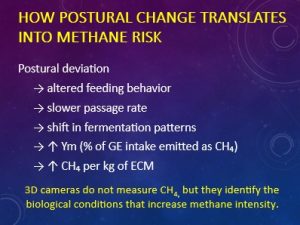
These early signals reflect discomfort, but more importantly, they reflect changes in how the cow interacts with her environment. Feeding behavior is altered, and this directly affects rumen function. Passage rate can slow, fermentation patterns shift, and methane yield increases.
By the time lameness is detected visually, these processes have already been affecting efficiency for some time. From a methane perspective, the increase in methane intensity has already begun.
Connecting behavior to methane production
Understanding the link between behavior and methane requires connecting external observations to internal processes.
Changes in posture and locomotion influence feeding behavior. A cow experiencing discomfort is less likely to spend time eating or may eat in shorter, less consistent bouts. This alters the pattern of nutrient intake entering the rumen. These changes affect rumen kinetics. A reduction in feeding frequency or changes in intake pattern can slow passage rate. When passage slows, hydrogen accumulates, and fermentation shifts toward pathways that produce more methane.
This creates a chain of events that begins with behavior and ends with methane intensity. Postural changes lead to altered feeding behavior, feeding behavior affects fermentation, and fermentation determines methane yield.
The key is that methane intensity is the final expression of this biological chain. It is not the starting point, but the outcome of multiple interacting processes.
A cow-level example
The relationship between intake, milk production, and methane intensity can be illustrated with a practical example. Consider a cow experiencing a moderate increase in locomotion score. Research suggests that intake may decline by approximately 3 to 5 percent per unit increase in score. In practical terms, this may correspond to a reduction of about 1 to 2 kilograms of dry matter per day. Milk production, however, typically declines more sharply. A reduction in intake of this magnitude may lead to a loss of 2 to 3 kilograms of energy-corrected milk per day, depending on diet and stage of lactation.
When methane production is estimated based on intake, the reduction in methane output is relatively small. However, when methane is expressed per kilogram of milk, the increase in methane intensity becomes clear. In some scenarios, methane intensity can increase by more than 10 percent even though total methane production declines slightly.
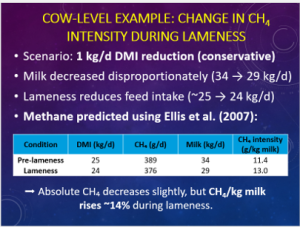
This example illustrates why methane intensity must be understood in the context of efficiency. Without considering production, changes in methane output can be misleading.
The recognition that inefficiency develops early creates an opportunity for improved management. If early changes in behavior and posture can be detected, interventions can be implemented before efficiency losses accumulate.
Advances in monitoring technologies make this possible. Systems that track posture, gait, and activity can identify changes that preceded visible lameness. Traits such as back posture, head movement, and tracking patterns provide valuable information about the cow’s physical state.
These tools do not measure methane directly. Instead, they identify the biological conditions that lead to increased methane intensity. By detecting these conditions early, they allow producers to respond sooner and more effectively.
Beyond the individual cow
The effects of inefficiency extend beyond individual animals. Health disorders increase the likelihood of involuntary culling, which in turn affects herd structure. Replacement animals are typically less efficient, particularly in early lactation, and produce more methane per unit of milk.
Improving health and extending productive lifespan reduces the need for replacements and spreads emissions over a larger volume of milk. This reduces methane intensity at the herd level.
From this perspective, health management is not only a welfare or production issue. It is also a practical and scalable methane mitigation strategy.
Conclusion
Methane intensity is best understood as a reflection of biological efficiency rather than a simple measure of emissions. It is influenced not only by diet and intake, but also by health, behavior, and rumen function.
Inefficiency develops gradually and often begins before it becomes visible. Detecting these early changes provides an opportunity to improve both productivity and environmental performance.
A more effective approach to methane mitigation therefore requires a broader perspective, one that integrates nutrition, health, and monitoring. By focusing on the biological processes that drive efficiency, dairy systems can move toward more proactive and sustainable management.
Continued progress in this area will depend on the ability to translate biological understanding into practical tools and on-farm decisions, where improvements in efficiency can be realized under real production conditions.
The full list of references used in this article is available upon request.
© 2026 Dellait Knowledge Center. All Rights Reserved.