
Álvaro García
For decades, dairy producers have been trained to watch ketones as a warning sign of trouble in transition cows. Elevated beta-hydroxybutyrate (BHB) is typically associated with ketosis, reduced milk yield, and suboptimal reproductive performance. As a result, most management strategies focus on keeping cows below well-established thresholds, especially after calving. But what if those targets are only telling part of the story?
A growing body of research suggests that the metabolic status of the cow before calving does more than influence her own performance; it may also shape how well her calf is prepared for life outside the uterus. This idea, often referred to as fetal programming, is gaining attention in dairy systems, particularly as producers push for greater efficiency and lower early-life losses.
One of the key tissues involved in this process is brown adipose tissue (BAT), sometimes called “brown fat.” Unlike regular body fat, BAT plays a critical role immediately after birth by generating heat. This allows the calf to maintain body temperature without relying on shivering, especially under cold or stressful conditions. It also contributes to early metabolic stability, including how effectively the calf can regulate blood glucose.
A very recent study conducted on a commercial dairy farm in China and published in the Journal of Dairy Science, examined how differences in maternal BHB during the dry period influenced calf development and early-life health. Researchers compared calves born from cows with low versus moderately elevated BHB levels during the dry period. Importantly, the cows in the higher-BHB group were not clinically ketotic, with BHB concentrations averaging around 0.6 mmol/L, well below the commonly accepted threshold for subclinical ketosis (≥1.2 mmol/L). The calves appeared no different. Birth weight, body size, and early growth were the same between groups. On a commercial farm, these animals would be considered equal.
A closer look told a different story
Calves from cows with higher BHB levels had less developed BAT and reduced expression of key thermogenic proteins responsible for heat production. Their mitochondrial density, the engine behind cellular energy production, was also lower. In practical terms, this suggests a reduced capacity to generate heat and respond to environmental challenges. These calves also showed signs of altered metabolic function, particularly in their ability to regulate blood glucose. In addition, they experienced higher rates of digestive and respiratory issues during the first month of life, including more frequent diarrhea and coughing.
Taken together, the findings point to an important conclusion: calves can be metabolically disadvantaged even when they look completely normal at birth. This has direct implications for on-farm management. Traditionally, success in the dry period has been measured by cow-focused outcomes, smooth calvings, low disease incidence, and strong milk production after freshening. But this research suggests that the definition of success should be broader. The metabolic condition of the dam during late gestation may influence calf resilience in ways that are not immediately visible.
For producers, this raises a practical question: are we aiming for cows that are simply “not ketotic,” or cows that are metabolically optimized for both their own performance and the development of their calves?
The distinction matters. In this study, the differences in BHB were modest and still below the threshold typically used to define subclinical ketosis. Yet those differences were enough to alter key aspects of calf physiology. This suggests that even mild elevations in ketones during the dry period may have biological consequences.
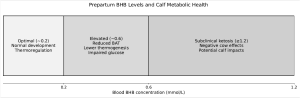
Figure. Relationship between maternal blood BHB concentrations during the dry period and calf metabolic outcomes. Even moderate levels (~0.6 mmol/L), within the normal physiological range and below the subclinical ketosis threshold (≥1.2 mmol/L), may impair BAT development, thermoregulation, and glucose metabolism in neonatal calves.
It also helps explain why some calves struggle despite appearing normal at birth and receiving adequate colostrum and care. In these cases, the issue may not be what happens after birth, but rather what happened before.
From a management standpoint, this reinforces the importance of consistency during the dry period. Maintaining stable feed intake, minimizing stress, avoiding excessive body condition, and supporting energy balance are all familiar recommendations, but this research adds another layer of motivation. These practices are not only protecting the cow; they are also helping to build a more resilient calf.
When and how to monitor BHB in dry cows
If maternal BHB during the dry period can influence calf strength, the next logical question is how to measure it on-farm in a practical and reliable way.
In most dairy systems, ketone monitoring is focused on fresh cows. However, this study suggests there may be value in shifting some attention earlier, particularly during the close-up period (last 3 to 4 weeks before calving). This is when fetal growth is rapid and when BAT development is most active, making it a critical window for metabolic programming.
Blood BHB can be measured easily using handheld meters that are already widely used for fresh cows. Samples are typically collected from the coccygeal (tail) vein or artery, which is practical under farm conditions and requires minimal restraint. For consistency, it is best to sample cows at a similar time of day, ideally before feeding, as feeding can influence circulating metabolites.
Rather than testing every animal, a targeted approach is often sufficient. Sampling a subset of close-up cows, particularly those that are overconditioned, have reduced feed intake, or are experiencing social or environmental stress, can provide a good indication of herd-level metabolic status. Repeated measurements over the close-up period can also help identify cows with persistently elevated BHB rather than transient fluctuations.
Interpreting the results requires a slightly different mindset than in fresh cows. While values above 1.2 mmol/L remain a clear concern for ketosis, this research suggests that even moderate elevations around 0.5 to 0.7 mmol/L during the dry period may warrant attention, especially if they are consistent across multiple animals. The goal is not simply to avoid disease, but to maintain a metabolic environment that supports optimal fetal development.
In practice, this means that BHB monitoring in late gestation can become a useful management tool, not only for improving transition success in cows, but also for producing calves that are better equipped to handle the challenges of early life.
Practical protocol for monitoring BHB in close-up cows
- Focus on the last 3–4 weeks before calving (close-up period)
- Sample cows once weekly, or at least 1–2 times before calving.
- Preferably test in the morning, before feeding, for consistency
- Evaluate a representative group (8–12 cows) in the close-up pen.
- Prioritize cows that are:
- Overconditioned (high BCS),
- Showing reduced feed intake,
- Recently regrouped or stressed.
How to sample:
- Use a handheld BHB meter (same as for fresh cows)
- Collect a drop of blood from the tail vein (coccygeal vessel)
- Ensure clean technique to avoid contamination.
How to interpret results:
- <0.3 mmol/L → Optimal metabolic status
- 0.3–0.6 mmol/L → Acceptable, monitor consistency
- 0.6–1.0 mmol/L → Elevated; potential impact on calf metabolic development
- ≥1.2 mmol/L → Subclinical ketosis; requires intervention.
- If multiple cows consistently test ≥0.6 mmol/L, review:
- energy balance and ration formulation,
- feed access and bunk space,
- stocking density and regrouping stress
Key takeaway: The goal is not only to prevent ketosis, but to maintain a stable metabolic environment during late gestation, supporting both cow performance and calf resilience.
It may also be worth rethinking how and when metabolic monitoring is used. While most farms focus on fresh cows, there may be value in paying closer attention to metabolic indicators during late gestation, particularly in herds where calf health challenges persist without an obvious cause.
None of this means that every calf from a higher-BHB cow will struggle, or that current management practices are inadequate. Rather, it highlights a subtle but important shift in perspective. Calf quality is not determined solely at birth; it is influenced by the metabolic environment in which the fetus develops.
Why this matters economically?
From a business standpoint, these findings touch a critical but often hidden cost center in dairy production: subclinical losses in calf performance. A calf that requires more treatments for scours or respiratory disease, struggles with thermoregulation, or shows reduced metabolic efficiency may not stand out individually, but across a herd, these small disadvantages accumulate. Increased labor, higher treatment costs, greater antimicrobial use, and reduced early-life efficiency all add up. More importantly, early metabolic stress has been linked in other research to poorer lifetime performance, including reduced growth efficiency and lower first-lactation yield.
What makes this particularly relevant is that these losses originate from cows that would typically pass all transition monitoring benchmarks. In other words, they represent a missed opportunity rather than a visible failure. By improving metabolic stability during the dry period, even within ranges already considered acceptable, producers may unlock value through healthier calves, fewer interventions, and more consistent long-term performance. In that context, better control of prepartum BHB is not just a health strategy, it becomes a return-on-investment decision that extends into the next generation of the herd.
The full list of references used in this article is available upon request.
© 2026 Dellait Knowledge Center. All Rights Reserved.