
Álvaro García
Walking, grazing, and the mechanics of moving across a landscape impose energetic costs on dairy cows, costs that are frequently underestimated in pasture-based dairy systems. The classical framework for accounting for this activity originates in the Nutrient Requirements of Dairy Cattle (NRC 2001), which assigns explicit allowances for walking on level ground and on slopes. Although these values remain the formal basis incorporated into ration formulation systems, the evidence accumulated over the last decade, particularly from research in Uruguay, New Zealand, and Ireland, suggests that NRC understates the genuine cost of locomotion under grazing conditions.
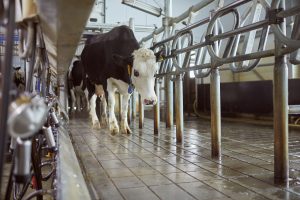
Walking between the parlor and the paddock
The NRC (2001) estimates that each kilometer of horizontal walking requires 0.00045 Mcal of NEL per kilogram of body weight. This means that a 600-kg Holstein cow expends approximately 0.27 Mcal of NEL per kilometer, an amount that grows quickly across the repeated trips typical of grazing systems. A cow walking 2 km/day expends a little over half a megacalorie; one walking 4–6 km/day may expend more than a full Mcal. NRC also notes that the cost of walking is not simply proportional to body weight and distance: slope markedly amplifies the requirement, as vertical ascent requires far more muscular work than horizontal movement.
Even so, the NRC’s values derive from controlled experiments, typically treadmill studies, which assume level footing, consistent pacing, and uniform locomotion. On real farms, laneways may be muddy, gates may slow cows or cause bunching, and slopes may appear repeatedly over the course of the day. These conditions introduce inefficiencies in gait and balance; they force cows to make corrective movements, stabilize joints, or accelerate in short bursts. Thus, while NRC offers an essential baseline, it underrepresents the true locomotion cost on commercial pasture systems.
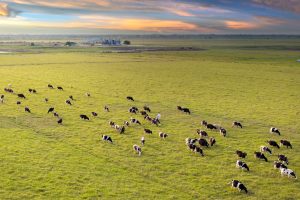
Walking within the paddock: Grazing as an energetic activity
Grazing itself is a form of locomotion. Cows do not stand in one place to harvest pasture; instead, they traverse the paddock, repeatedly repositioning to take bites of variable height, density, and maturity. NRC acknowledges that grazing increases energy expenditure beyond what is observed in confinement, but it does not quantify grazing-specific costs precisely, instead incoporating them under a general category of “activity.”
Recent research from Uruguay, particularly the work of Talmón and colleagues, has filled this gap by quantifying grazing-related energy costs using modern methods. Their 2025 study used the oxygen-pulse–heart-rate technique to measure heat production during discrete activities, lying, ruminating, grazing, walking to and from pasture, in cows consuming varied pasture swards. Grazing cost the cows roughly 6.6–7.8 kJ/kg^0.75 per hour (0.00158–0.00186 Mcal NEL/kg^0.75 per hour), significantly more than idling or ruminating, and walking itself (at approximately 3 km/h) cost around 24 kJ/kg^0.75 per hour (0.00574 Mcal NEL/kg^0.75 per hour). These values imply that the total daily energy spent on grazing-related movement is far higher than NRC’s generalized activity allowance would suggest. Pasture structure further alters energy cost. Dense, uniform swards with high leaf-to-stem ratios permit cows to harvest larger bite masses with fewer steps, resulting in lower locomotion cost per kilogram of intake. By contrast, sparse, patchy, or mature pastures, common late in a grazing rotation or during dry periods, force cows to travel more per unit of dry matter, raising energetic expenditure. Multiple behavior-monitoring studies have shown that cows walking greater distances, whether to the parlor or within the paddock, spend more time grazing and less time ruminating, indicating a shift in time budgets driven by increased activity demand.
Environmental conditions as multipliers of energy cost
Beyond distance and forage structure, the environment modifies walking cost. Muddy laneways increase resistance and reduce traction, forcing cows to take shorter strides with greater muscular effort. Wet or slippery ground triggers corrective movements that increase oxygen consumption. High ambient temperatures add heat stress to muscular heat production, while cold, wet conditions elevate both basal metabolic rate and the energy required to walk.
Although these conditions are not explicitly quantified in NRC, field studies demonstrate their importance. Research tracking activity and rumination in cows walking up to 4 km/day shows that longer walking distances correlate with reduced rumination and altered lying patterns, indicators that the cumulative energetic and environmental burden is sufficiently high to shift core behaviors necessary for health and production.
Metabolic evidence supporting higher costs in pasture systems
Physiological research offers additional insight. Studies of hepatic metabolism in grazing cows, such as those by García-Roche and collaborators, reveal that cows under high-pasture systems, which require more walking and more time grazing, display altered hepatic triglyceride accumulation, modified mitochondrial function, and changes in fatty-acid oxidation pathways during early lactation compared with cows receiving more TMR. These metabolic differences suggest that grazing cows are not merely expending more energy on walking; they are experiencing distinct physiological pressures associated with pasture-based management, including fluctuating intake rates, variable forage quality, and sustained locomotion requirements.
Reconciling NRC with modern evidence
The NRC framework offers a simple, uniform method of accounting for activity, and its locomotion values remain widely used in feeding systems throughout the world. Yet it was developed from controlled walking studies, without the complexity of real pasture conditions. Recent field-based research suggests that the total maintenance requirement of cows in pasture systems may be underpredicted by NRC by 20–25% or more, depending on terrain, distance, pasture density, and environmental conditions.
For ration formulation, this gap has practical consequences. Underestimating maintenance energy can inadvertently place cows in negative energy balance, reduce milk production, compromise body condition, or impair fertility, especially when cows walk long distances or graze mature pastures. Incorporating updated, research-derived values such as those from Talmón et al. or adjusting NRC’s activity multipliers to reflect farm-specific conditions can improve both productivity and animal welfare.
Practical feeding implications for grazing dairy cows
The updated locomotion and grazing energy costs allow for farm-level adjustments in concentrate allocation to better match the true activity demands of grazing cows. Although exact requirements vary by body weight, pasture structure, and environmental conditions, the following guidelines provide practical, defensible estimates for a typical 600-kg Holstein in mid-lactation.
Additional concentrate per kilometer walked
NRC (2001) estimates:
- 0.27 Mcal NEL per km for a 600-kg cow.
Field data suggests NRC is 20–25% low, so a more realistic estimate is:
- 0.32–0.34 Mcal NEL per km under real grazing conditions.
Practical feeding rule
- Add 0.3–0.35 Mcal NEL (≈0.20–0.25 kg of typical concentrate) per km walked.
Examples:
- 2 km/day: +0.4–0.5 kg concentrate
- 4 km/day: +0.8–1.0 kg concentrate
- 6 km/day: +1.2–1.5 kg concentrate
Cows walking long distances to the parlor or water frequently require one extra kg/day or more.
Adjustments for pasture density (sparse vs. lush)
Talmón’s data shows that sparse or mature pastures increase grazing energy cost because cows walk farther per unit of intake and take more steps per bite.
Approximate differences:
- Lush, dense sward: Energy cost ≈ baseline
- Moderate pasture: 5–10% more energy
- Sparse, patchy, or mature pasture: 10–20% more energy
Practical feeding rule
- Add 0.3–0.5 kg concentrate/day in moderate pasture.
- Add 0.6–1.0 kg concentrate/day in sparse or mature pasture.
If pasture really deteriorates (late rotation, summer slump), this may need to increase to 1.2 kg.
Environmental conditions (heat, mud, slopes)
Mud
- Increases energy cost of walking by 20–40% depending on depth and slipperiness.
- Add 0.3–0.6 kg concentrate/day in muddy periods.
Heat stress (THI > 68)
- Cows reduce bite size and increase heat load → more steps per unit of feed harvested.
- Energy cost rises 10–15%.
- Add 0.2–0.4 kg concentrate/day during heat stress.
Cold + wet conditions
- Increases maintenance requirements 10–20%.
- Add 0.3–0.6 kg concentrate/day during cold rains or winter grazing.
Slopes
- NRC suggests inclines dramatically increase cost:
Walking uphill may require 2–3× more NEL than level walking. - Farms with significant slopes: add 0.5–1.0 kg concentrate/day.
How to use this on a farm
- Estimate km/day walked (GPS collars, simple maps or timed since cows walk ≈ 3 km/h).
- Evaluate pasture quality daily.
- Check environmental modifiers (mud, heat, cold).
- Adjust concentrate accordingly, in increments of 0.2–0.3 kg, to avoid digestive upset.
These adjustments help avoid negative energy balance, protect fertility, and support persistent milk yield, especially during early lactation, long walking distances, or challenging grazing conditions.
Conclusions
Walking and grazing impose significant, measurable, and often underappreciated energy costs on dairy cows. NRC (2001) provides a critical starting point for evaluating these costs, but real grazing systems introduce environmental, behavioral, and metabolic complexities that exceed classical allowances. Contemporary research, including work from Uruguay and other pasture-intensive regions, provides refined estimates that align more closely with the lived realities of grazing cows. Recognizing and incorporating these updated values into nutritional management is essential for sustaining performance, health, and welfare in modern pasture-based dairy systems.
The full list of references used in this article is available upon request.
© 2026 Dellait Knowledge Center. All Rights Reserved.